Thursday, August 8, 2024

Home Front: Dried food stew

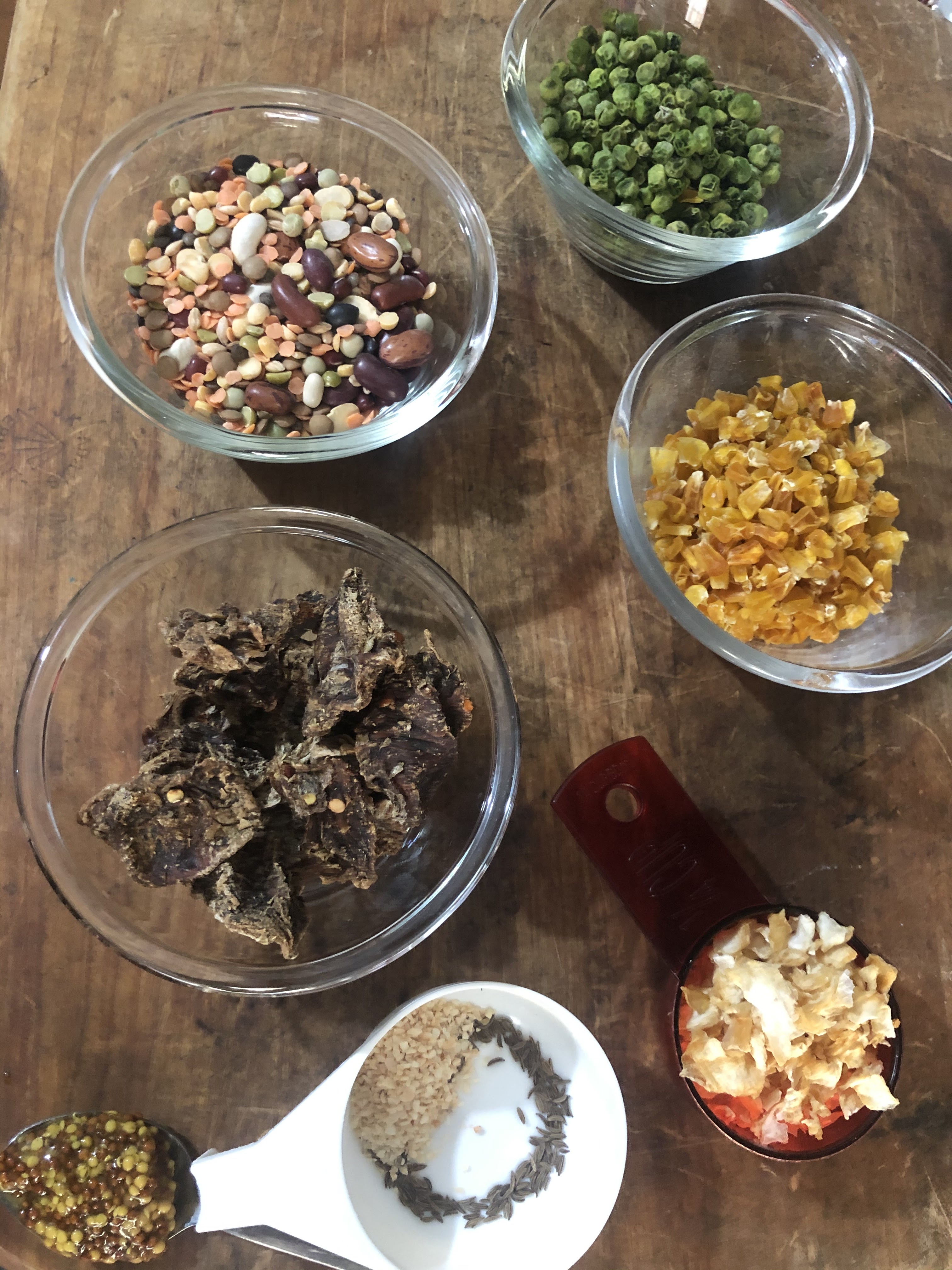
 Pushing on with a food and meals theme, I thought i'd make a start with this simple meal. I started out by collecting my ingredients. I'm a big fan of dehydrating food and I wanted to try my home-dehydrated items out. I had bought and dehydrated bags of frozen peas, corn and diced onion. ( hint for the novice, do these all separately to avoid mixing when they fall through the grills when shrunk by dehydration).1kg  frozen peas yielded 252g and 1kg frozen corn yielded 223g corn kernels. Pictured here was 1 cup of each, a half cup of dehydrated onion, 1 cup of  "soup mix" (beans, split peas, lentils,  I also used a handful of  hard jerky I had made, cut into 1" squares, a tablespoon of seedy mustard, and a half teaspoon each of granulated garlic and fennel seeds. So the only wet ingredient was the mustard. The rest could be stored in a sack and if in a decent jar, would last pretty much indefinitely.  


It was light on seasoning, but I wanted to make as minimalist a meal as possible, to see what little you could get away with and still have a palatable meal. 

I wanted to push the rustic angle so 
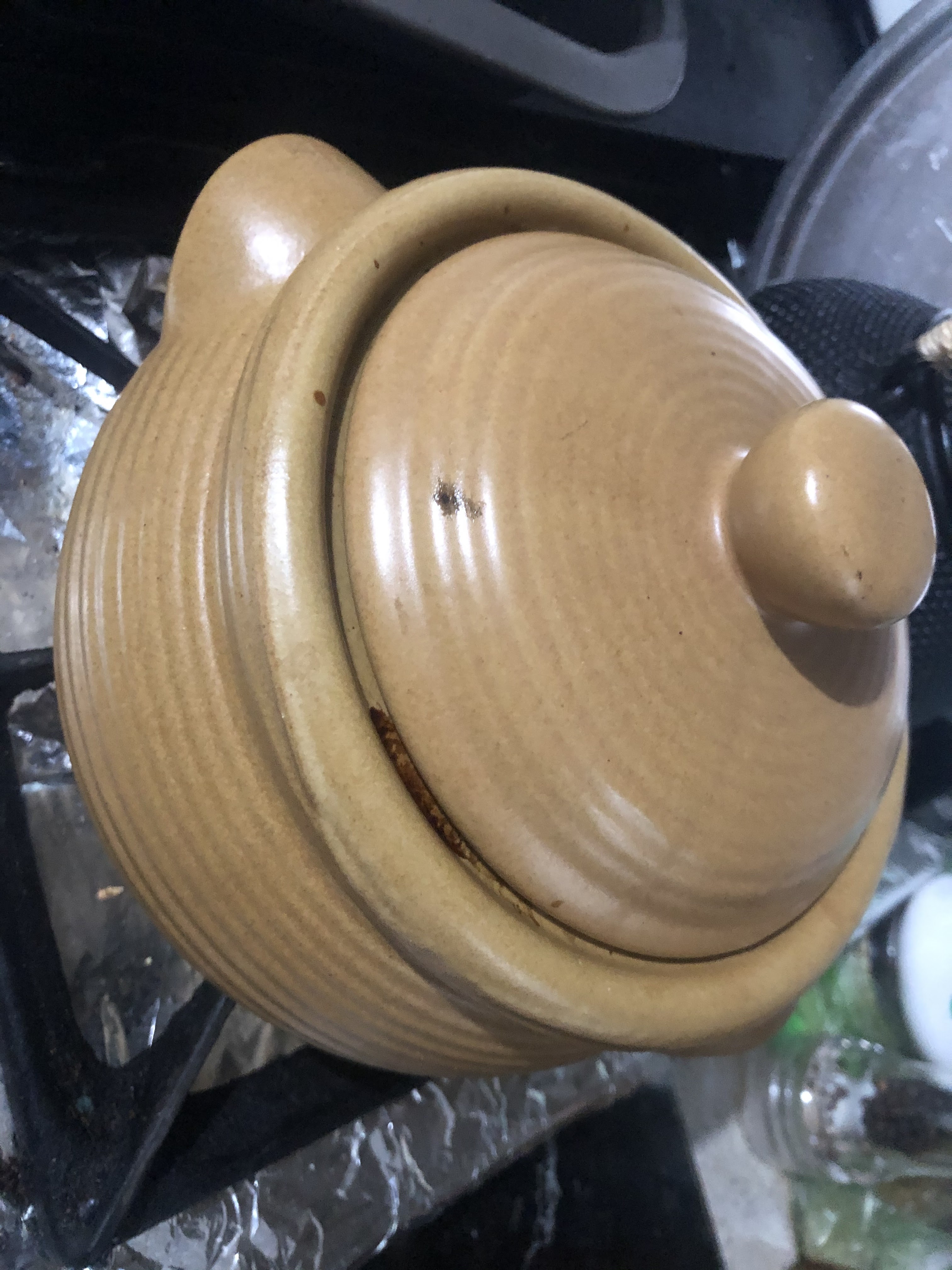
I opted to prepare this in a piece of stoneware I had acquired at an op-shop. This  Stoneware Tureen had a close fitting lid and wing-handles and similar items can be found elsewhere too. I put all the ingredients into the tureen and added 6 cups of water, put the lid on and put it in the oven on low for a number of hours. 

With plenty of water and a long and slow cook everything re-hydrated nicely and with a couple of stirs to blend flavours, it came together nicely. The jerky softened up and the peppery marinade I had made it with blended into the stew just a little, but pleasantly so.

The peas, soup mix and onions all softened up and thickened the soup into a hearty stew. The corn re-hydrated about 70%, enough to be tender, but not juicy. 

I tested it after a couple of hours, stirred it and  added a little more water then left it to bake some more. The beef softened up but was still a bit tough. smaller chunks or perhaps some beating to soften the fibres might help next time. 

I cooked it down till there wasn't any standing liquid, which might have been a mistake, but it was soft, not soggy when I decided it was "ready" and ladled myself out a serve. It smelt great whilst slow cooking and whilst not exciting to look at, was both surprisingly tasty and filling, with a couple of good ladle fulls making a solid meal and this made several servings worth. 

If and when i make this again, I think id use beer or stock for the liquid base, and add some form of fat or oil just to bolster it and add richness. Perhaps bacon or spec in chunks?

Some additional seasoning wouldn't go astray, perhaps even just a bay leaf or two. 

It was certainly a good way to make use of my dehydrated ingredients and made a very satisfying set of meals for what would be a very light  batch of ingredients (I forgot to measure, bad scientist).

This kind of meal is called a pulse. It is very ancient and exceedingly simple to make. Next time with more rigorous record keeping. 
What else should I add? Might try dehydrating frozen carrot next. 

This is certainly a meal one cold make in the coals of a campfire, even semi-buried in ashes and returned too after ranging for a solid evening meal. Well worth trying, even with the risk of burning. 

dehydrated MRE style meal


Saturday, July 20, 2024

Review Oceanus Brass - Cablelaid cordage cutter

Here's another solid brass tool to add to my loadout of adaptive hardware. I'm always looking out for tools that can help me adapt to my environment or supplement my resources, especially if normal resources are unavailable or scarce. This particular tool turns plastic drinking bottles into cordage!

You'd be pressed pretty hard to wander too far anywhere and not find modern trash. Plastic drinking bottles get thrown out of cars along roadways, get blown or dumped into waterways and turn up all over the place. The trick is to turn this abundant waste into useful product! Thats where a tool like the Cablelaid by Oceanus Brass comes in. Machined from solid brass bar stock, the tool is based around a simple principle; a razorblade, held in place behind a channel to feed the leading edge of the plastic through and cordage out the other side. 

The top plate of the tool is held in place by three inset Alan key screws, to facilitate swapping out of the simple razor blade in the event it dulls, though flipping it would double your cutting mileage, before replacement or sharpening is required. 

The tool has three channels built into the side that both guide the bottle in to the razor edge but also set the width of the cord produced. Notches set at 8mm, 6mm and 4mm to the blade with a 2mm guide slot along the top of the tool. The tool works by cutting the end of a plastic bottle off, then feeding the edge into the desired notch and the razor begins to cut the bottle into cordage. the notch then feeds the bottle in measured width to the razors edge and cordage exits out the back of the tool. 

In order to maintain a constant pressure on the cutting edge and even bind-free cutting, it is beneficial to mount the bottle to the tool, such that it spools.


To facilitate this, the tool has a hole bored through it, that fits a pen, pencil or the purpose made telescoping feed rod, its also helpful to anchor the tool in place, and a couple of nails serve the purpose well. Thus braced, its a matter of cutting an even strand, which takes a little finesse, and more than a few false starts. The more even the initial cut of the bottle is the better the start will be. as notched cord is weak and often snaps as it is drawn off the bottle. 

I found that gripping the end of the cord in some pliers made for a good method, allowing me to focus on keeping an even tension on the cord, such that an even cutting would take place, free from pinching and mis-angled cuts. 


From a standard 1.25L soft drink bottle, with a good clean start and careful processing i've been able to reliably cut 10-12m (32-40') of 8mm wide cord.

I've found that removing the label and washing out any sticky residue helps keep the cutting smooth and steady, but the first, initial cut to remove the base of the bottle seems most important. I also found that cutting from bottom to top is most successful.


The tool is pocket sized, at 114mm (~4 1/2") long,  23mm~15/16") wide and  11mm(~7/16") tall weighing a solid 184g (~6.5oz) but it'r rock solid and comfortable in the hand the way that solid brass is.

It can take either standard razor blades or alternatively box cutter blades, which fit into machined spots inside the tool. 

The tail end of the tool features a lanyard hole, and comes fitted with a brass Bow-Shackle that is the signature of Oceanus Brass products. Versatile and useful on its own. A final nice touch is that the tool came with replacement blades, spare screws and Alan key as well as the telescopic rod in an all-included package.

Though the art of bottle-cordage conversion requires a certain finesse and practice, it's well worth attempting as an alternative to bought cord and thus far I've found a number of uses around the house and in the garden. More to follow.


Related Posts Plugin for WordPress, Blogger...